
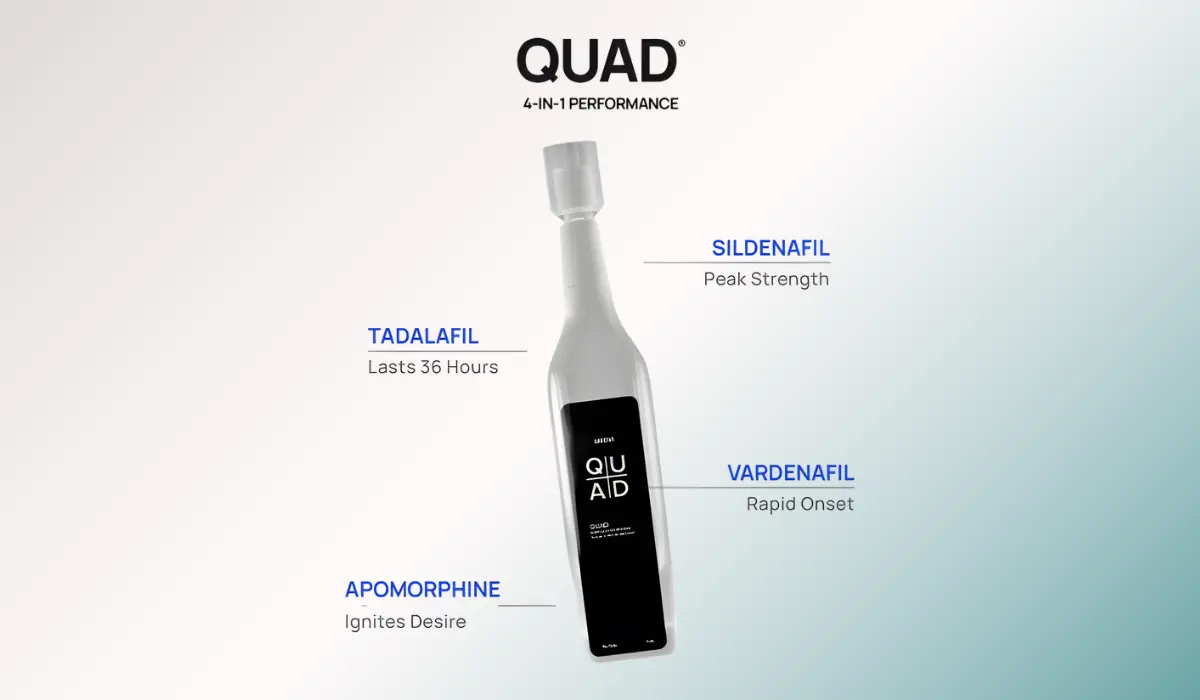
MEDVi Quad combines four clinically used compounds to support erectile function through multiple pathways. Instead of relying on a single ingredient, it targets both blood flow and neurological response for more complete support.
The formula includes tadalafil, sildenafil, vardenafil, and apomorphine. While the PDE5 inhibitors enhance circulation, apomorphine works on brain pathways related to arousal.
This multi-action approach is designed to provide faster onset and more consistent results under medical supervision. Learn more in our complete MEDVi Quad review.
Tadalafil
Tadalafil is a prescription medication primarily used to treat erectile dysfunction (ED) and symptoms of benign prostatic hyperplasia (BPH), a condition involving an enlarged prostate. It belongs to a class of drugs known as phosphodiesterase type 5 (PDE5) inhibitors.
Tadalafil works by increasing blood flow to specific areas of the body, particularly the penis, which helps men achieve and maintain an erection when sexually stimulated. Unlike some similar medications, tadalafil is known for its long duration of action, often lasting up to 36 hours, which is why it is sometimes referred to as the “weekend pill.”
In addition to ED, tadalafil may also be prescribed to improve urinary symptoms such as difficulty urinating or frequent urges caused by BPH. It is available in different dosages and can be taken either as needed or once daily, depending on the treatment plan recommended by a healthcare provider.
Overall, tadalafil is a clinically proven, widely used medication that supports improved sexual performance and urinary function when used under proper medical guidance.
Scientific References on Tadalafil
Below is a curated list of credible scientific and clinical references that support the pharmacology, mechanism, and clinical use of tadalafil:
- Fahmy G, et al. (2024).Tadalafil – StatPearls.
- Describes tadalafil as a selective PDE5 inhibitor that prevents cGMP breakdown, enhancing vasodilation and erectile function.
- Describes tadalafil as a selective PDE5 inhibitor that prevents cGMP breakdown, enhancing vasodilation and erectile function.
- Coward RM, et al. (2008).Tadalafil in the treatment of erectile dysfunction.
- A comprehensive review covering tadalafil’s pharmacology, clinical trials, safety, and efficacy in ED management.
- A comprehensive review covering tadalafil’s pharmacology, clinical trials, safety, and efficacy in ED management.
- Arif SA, et al. (2011).Tadalafil: A long-acting phosphodiesterase-5 inhibitor.
- Highlights tadalafil’s high selectivity for PDE5 and long half-life (~17.5 hours), contributing to prolonged therapeutic effects.
Sildenafil
Sildenafil is a prescription medication commonly used to treat erectile dysfunction (ED) and, in some cases, pulmonary arterial hypertension (PAH). It belongs to a class of drugs known as phosphodiesterase type 5 (PDE5) inhibitors.
Sildenafil works by relaxing blood vessels and increasing blood flow to specific areas of the body. In men with ED, this improved blood flow helps achieve and maintain an erection during sexual stimulation. It does not cause an automatic erection and requires arousal to be effective.
One of the key characteristics of sildenafil is its relatively fast onset of action. It typically starts working within 30 to 60 minutes and remains effective for about 4 to 6 hours. Because of this shorter duration compared to some alternatives, it is usually taken on an as-needed basis before sexual activity.
Sildenafil is widely recognized as the active ingredient in Viagra, one of the most well-known treatments for ED. It is available in different strengths and should be used under medical supervision to ensure proper dosage and safety.
Overall, sildenafil is a clinically proven and widely prescribed medication that helps improve sexual performance and confidence when used appropriately.
Scientific References on Sildenafil
Below is a curated list of peer-reviewed studies and authoritative sources supporting the pharmacology, mechanism, and clinical use of sildenafil:
- Goldstein I, et al. (1998).Oral sildenafil in the treatment of erectile dysfunction. New England Journal of Medicine.
- Landmark randomized trial demonstrating sildenafil’s effectiveness and safety in men with ED.
- Landmark randomized trial demonstrating sildenafil’s effectiveness and safety in men with ED.
- Boolell M, et al. (1996).Sildenafil: An orally active type 5 cyclic GMP-specific phosphodiesterase inhibitor for the treatment of penile erectile dysfunction. International Journal of Impotence Research.
- Early clinical study explaining sildenafil’s mechanism via PDE5 inhibition and enhanced cGMP signaling.
- Early clinical study explaining sildenafil’s mechanism via PDE5 inhibition and enhanced cGMP signaling.
- Nichols DJ, et al. (2002).Sildenafil pharmacokinetics in healthy volunteers. British Journal of Clinical Pharmacology.
- Details absorption, metabolism, and elimination profile of sildenafil.
Vardenafil
Vardenafil is a prescription medication used to treat erectile dysfunction (ED) in men. It belongs to a class of drugs called phosphodiesterase type 5 (PDE5) inhibitors, which help improve blood flow to the penis during sexual stimulation.
Vardenafil works by relaxing the blood vessels, allowing increased circulation that makes it easier to achieve and maintain an erection. It does not cause an automatic erection and requires sexual arousal to be effective.
This medication is known for its relatively fast onset, typically working within 30 to 60 minutes after intake, and its effects can last for about 4 to 6 hours. It is usually taken as needed before sexual activity.
Vardenafil is the active ingredient in brand-name medications like Levitra and Staxyn, which are commonly prescribed for ED treatment.
Overall, vardenafil is a clinically proven option for men seeking reliable, on-demand support for erectile function when used under proper medical guidance.
Scientific References on Vardenafil
Below is a curated list of peer-reviewed studies and authoritative sources supporting the pharmacology, mechanism, and clinical use of vardenafil:
- Porst H, et al. (2001).Efficacy of vardenafil for the treatment of erectile dysfunction: a randomized, double-blind, placebo-controlled trial. International Journal of Impotence Research.
- Demonstrates significant improvement in erectile function across diverse patient groups.
- Demonstrates significant improvement in erectile function across diverse patient groups.
- Hellstrom WJG, et al. (2003).Vardenafil treatment for erectile dysfunction: efficacy and safety in a broad population. Urology.
- Confirms consistent efficacy and tolerability in men with varying degrees of ED.
- Confirms consistent efficacy and tolerability in men with varying degrees of ED.
- Klotz T, et al. (2001).Pharmacokinetics and pharmacodynamics of vardenafil. Journal of Clinical Pharmacology.
- Explains absorption rate, bioavailability, and duration of action of vardenafil.
Apomorphine
Apomorphine is a prescription medication that acts on the brain’s dopamine receptors and is primarily used to treat conditions related to neurological function. It is commonly prescribed for managing symptoms of Parkinson’s disease, particularly sudden “off” episodes where movement becomes difficult.
In addition to its neurological use, apomorphine has also been used in certain cases to support erectile dysfunction (ED). Unlike PDE5 inhibitors, it works centrally in the brain by stimulating dopamine pathways that are involved in sexual arousal and response, rather than directly increasing blood flow.
Apomorphine is typically administered as a sublingual tablet or injection, depending on the condition being treated. When used for ED, it is designed to trigger a natural erectile response through brain signaling, but its use for this purpose is less common today compared to other treatments.
Overall, apomorphine is a fast-acting, dopamine-based medication that influences the central nervous system and is used under medical supervision for specific therapeutic purposes.
Scientific References on Apomorphine
Below is a curated list of peer-reviewed studies and authoritative sources supporting the pharmacology, mechanism, and clinical use of apomorphine:
- Olanow CW, et al. (2006).Apomorphine subcutaneous injection for the treatment of Parkinson’s disease “off” episodes. Neurology.
- Demonstrates the effectiveness of apomorphine in rapidly reversing motor fluctuations in Parkinson’s patients.
- Demonstrates the effectiveness of apomorphine in rapidly reversing motor fluctuations in Parkinson’s patients.
- Dewey RB Jr, et al. (2001).A randomized, double-blind, placebo-controlled trial of subcutaneous apomorphine for Parkinson’s disease. Archives of Neurology.
- Confirms rapid onset of action and improved motor control during “off” periods.
- Confirms rapid onset of action and improved motor control during “off” periods.
- Poewe W & Wenning GK. (2000).Apomorphine: an underutilized therapy for Parkinson’s disease. Movement Disorders.
- Reviews clinical benefits and practical use in managing advanced Parkinson’s disease